

Michelle Welton, Bass Coast Shire/South Gippsland, VIC
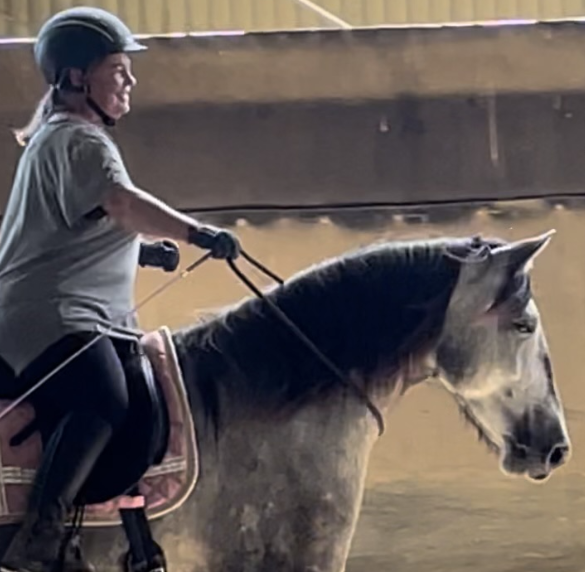
Michelle Welton, Bass Coast Shire/South Gippsland, VIC
Qualifications:
Bio
Sondela Equine Sports Massage Therapy
Growing up in a rural community in South Africa, my journey with horses started out unconventionally. I have fond memories of visiting family friends on their farms and getting up at the crack of dawn to catch the best horses to sneak out for a ride before the adults woke up. Learning to ride became a matter of stay on, keep up or get left behind. Most farm kids could ride just about any horse. We would set up obstacles and “practice” for the local gymkhana games, we would ride out, bobbing and weaving through farms to find the perfect gallop and we would spend hours discussing our next adventures. Amazingly, we survived.
At 16 years old, my constant nagging for a horse of my own finally paid off and my parents asked a local horseman and farmer to help out. I finally had a horse of my own (Jayess, 4-year-old Boerperd x American Saddlebred chestnut gelding) and I had to learn fast. My riding consisted of rides to the nearby beach and sand dunes, rides through the local farms and rides into the town, mostly bareback, barefoot, and carefree.
Our local community equestrian sports were gymkhana games, polo crosse, agricultural shows, endurance riding and what we called “commando” rides – similar to trekking. My horse and I tried them all with agricultural shows and trekking being our favourites.
The time came for me to move to the city, and with that move came a significant change in both my life and the lives of my horses. By then, I no longer had my gelding and instead owned three chestnut mares: Nikita, an Anglo-Arab, Mystery, a Boerperd × American Saddlebred and Really a Star, a Warmblood mare.
City life introduced a very different equestrian environment. My horses’ lives were now vastly different from the more natural environment I had previously known. Stabled overnight, small day yards, concentrates twice daily and exercised primarily through ridden work or lunging. They were meticulously managed by teams of grooms, and at the time, this represented to me what good horse care and management looked like.
I competed in both showing and dressage, enjoying the challenge of developing a horse through training and seeing that work reflected in the competition arena. The opportunity arose to become a co-owner of a local riding school and naturally I jumped at the chance. Despite balancing a full-time corporate career and my own horses, I particularly enjoyed sharing my knowledge and experience with young riders and helping them develop their skills and confidence around horses.
After becoming a mother, I realised that I could not give motherhood, a demanding corporate career, and my horses the level of commitment I believed each deserved. I made the incredibly difficult decision to step away from horses completely.
In December 2013, our family immigrated to Australia.
Once we had established our new lives, however, it became increasingly clear that horses were not something I could simply leave behind. When I returned to them, I did so with a very different mindset. I no longer wanted simply to ride, train, and compete. I had a deep desire to understand the horse more completely.
I wanted to know why.
Why horses behave as they do. Why particular training methods work while others create conflict. How learning theory influences the horse-human relationship. How management affects physical wellbeing, psychological welfare, and quality of life. I became increasingly interested in sustainable horsekeeping, learning theory, ethical training, equine behaviour, and classical dressage.
In January 2020, I purchased my first horse in Australia—a young, green (and grey), Warlander gelding. After so many years away from horses, and now working with a young horse in a new country, I questioned whether my previous experience would be enough.
In many ways, those doubts became the catalyst for the direction my equestrian education would ultimately take.
A friend introduced me to Equitation Science International and suggested that I watch some of their material and read Equitation Science. I had found what I had been searching for.
I began regular groundwork and ridden lessons with Manuela McLean, attended as many clinics and educational opportunities as possible, and ultimately completed my Diploma in Equitation Science. Alongside my formal studies, I immersed myself in literature relating to equitation science, equine ethology, learning theory, biomechanics, and classical dressage. Continuous education became addictive which lead me to the Certificate in The Equiculture Sustainable Horsekeeping, Certificate in Applying the Five Domains Model to the Welfare Assessment of Sport and Recreational Horses and most recently, Certificate in Equine Sports Massage.
These areas of study have not replaced the experience gained during my earlier years with horses; rather, they have caused me to reconsider much of it through a different lens.
I can now look back at the horses I owned, trained, and competed differently. Practices that were considered entirely normal at the time—limited turnout, restricted opportunities for natural movement and social interaction, concentrate-based feeding, repetitive schooling and interpreting unwanted behaviour primarily as a training issue—are things I would now examine far more critically.
Today, my approach brings it all together. Rather than viewing these as separate disciplines, I see them as interconnected parts of understanding and supporting the whole horse.
Training cannot be considered independently of welfare. Behaviour cannot be separated from physical comfort. Muscular tension cannot be considered without looking at movement, workload, management, and training. Performance should not be pursued without considering the horse’s physical and mental experiences.
Through Sondela Equine Sports Massage Therapy, I combine my theoretical knowledge and qualifications with a lifetime of practical equestrian experience. Offering individualised and whole horse focused services with emphasis on collaboration between the owner, farrier, vet team, coach, and myself to find the best outcomes for the horse.
The greatest change in my equestrian journey has perhaps been the understanding that experience alone does not mean we stop learning. The horses I have known throughout my life have each contributed something to the way I think today, while education has given me the tools to question, refine and sometimes change what I once believed.
For me, good horsemanship is no longer simply about what we can achieve with a horse. It is about continually asking whether the way we train, manage and care for them supports their comfort, understanding, welfare and quality of life.
Memberships
- ISES Practitioner member
- ETAA Practitioner member
- International Institute for Complimentary Therapists (member and insurance)